
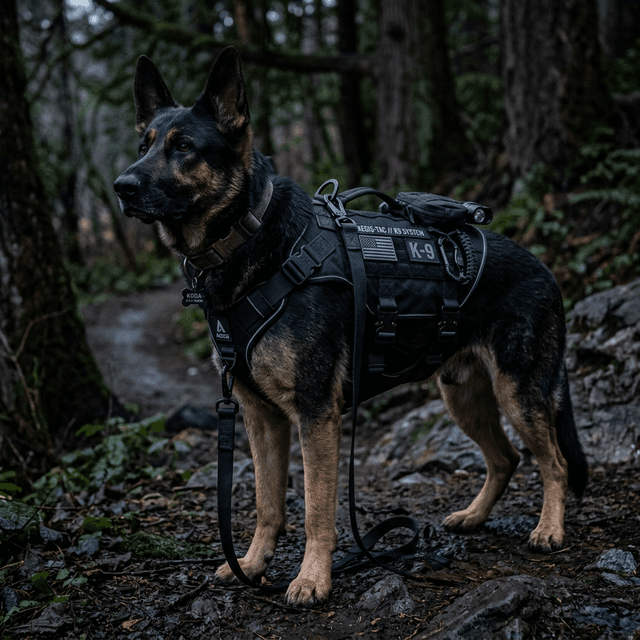
Tactical vs. Traditional: Why Your Cane Corso Needs a Working Harness
Let's be honest—if you own a Cane Corso, you already know that half the dog gear on the market wasn't built with your dog in mind. Those cute little padded harnesses hanging in the pet store? Designed for Labradoodles and rescue mutts that weigh forty pounds soaking wet. Your Corso? He's built like a Roman centurion and pulls like one too.
So here's the real question most owners eventually ask: does it actually matter *what* kind of harness you put on a dog this size? Short answer—absolutely. Long answer? Keep reading.
The Corso Body Is Its Own Engineering Problem
Before you spend a dime on gear, you need to understand what you're working with physically. Cane Corsos have a few anatomical quirks that make harness selection genuinely tricky.
First, that chest. It's deep—unusually so, even for a large breed. The sternum sits low, and the ribcage is wide and barrel-shaped. A harness with a narrow front panel? It'll sit wrong almost immediately, either riding up into the throat or slipping down and restricting elbow movement. Neither is good.
Then there's the elbow skin. This is the part most people overlook entirely. Corsos have relatively thin, sensitive skin around their elbow joints compared to, say, a Rottweiler or a Mastiff. Cheap harnesses with stiff nylon straps that cut across the chest and wrap under the leg? They will—and I mean *will*—cause chafing within a few weeks. Maybe sooner if your dog is active.
And let's not forget the neck-to-shoulder ratio. These dogs carry a lot of mass up front. A traditional flat collar for daily walks isn't just impractical; it's a liability. The leverage a 110-pound Corso generates during an unexpected lunge would have you airborne before you could say "leave it."
What "Traditional" Harnesses Actually Get Wrong
Standard harnesses—the kind with two loops, a plastic buckle, and a D-ring on the back—were designed for the average dog. And the Corso is anything but average.
Here's what typically goes wrong. Back-clip harnesses, despite being the most popular style sold, actually *encourage* pulling in large breeds. It's counterintuitive, but when the leash clips to the back, the dog leans into the pressure and uses their body weight as leverage. For a 120-pound Corso with a working dog's drive? You're basically giving him a sled harness.
Front-clip traditional harnesses are better in theory, but the execution often falls apart. The chest plate is usually too narrow, the sizing options max out at "large" when your dog needs something more like "large vehicle," and the stitching... honestly, it's not built for a dog that could drag a small car.
There's also the control issue. In a real-world scenario—a reactive moment at the park, a sudden bolt toward a squirrel—a traditional harness gives you almost nothing in terms of handling control. You're managing the situation from a single point on a dog that weighs as much as some adults.
Why Tactical Harnesses Change the Game
Tactical dog harnesses were originally developed for working K9 units—military, police, search and rescue. They weren't designed with aesthetics in mind. They were designed for *function*, and that distinction matters enormously when you're dealing with a breed like the Corso.
The build quality alone is different. We're talking about military-grade nylon webbing, double-stitched stress points, and metal hardware that won't pop open when things get exciting. The padding is typically thicker and contoured rather than flat, which distributes pressure more evenly across that wide Corso chest.
But the real advantage is the handle. Most tactical harnesses include a top-mounted grab handle, and once you've used one with a powerful dog, you'll wonder how you ever managed without it. Need to guide your Corso past a trigger? You grab the handle and redirect. Crossing a narrow trail with a cyclist coming fast? Handle. Loading into the car? Handle. It's an extra point of control that traditional harnesses simply don't offer.
Then there's adjustability. Good tactical harnesses typically have five or six adjustment points rather than two or three. That matters for Corsos because their proportions don't always match standard sizing charts—wide chest, thick neck, sometimes a more narrow waist. Getting a proper fit is less about picking "XL" and more about dialing in each strap independently.
The 3 Harnesses Worth Considering for Your Corso
After spending way too much time researching this—and yes, testing on a 105-pound male who has opinions about everything—here are the three harnesses that actually make sense for this breed.
Julius-K9 IDC Powerharness — The Julius-K9 has been around long enough that it's practically a standard in the working dog world. The chest piece is wide and sits correctly on a deep-chested breed, and the interchangeable velcro patches are a nice touch if you want to add ID or fun patches. It's not the most tactical-looking option, but the build quality is exceptional and sizing runs genuinely large.
OneTigris Tactical Dog Harness — This one leans fully into the military aesthetic, and more importantly, it backs it up. MOLLE webbing on the sides lets you attach pouches if you're hiking or doing any kind of trail work with your Corso. The handle is solid, the fit is adjustable enough to accommodate a Corso's unusual proportions, and it holds up remarkably well to daily use.
Ruffwear Front Range Harness — If your Corso is calmer and you're less focused on control and more focused on comfort during long outdoor activities, the Ruffwear Front Range is worth a look. It's not technically a tactical harness, but it's built to a higher standard than traditional options, fits deep-chested breeds well, and the padding is genuinely soft without compromising structure.
Getting the Fit Right (This Part Is Non-Negotiable)
Here's where a lot of people go wrong even after picking the right harness style—they size it based on weight alone. "My dog is 110 pounds so I'll grab the XL." That's not how this works.
For a Cane Corso, you need to measure the chest girth at the widest point, the neck circumference, and the length from the base of the neck to where the chest meets the belly. Then cross-reference those measurements against the manufacturer's actual sizing chart, not their weight guide. Having a solid read on your dog's expected size using the corso scale can also help you predict when they might outgrow their current harness.
Harness Sizing
Find the perfect tactical gear based on weight.
A properly fitted harness should sit snug but not restrictive—you're aiming for two fingers of clearance under every strap. If you can slip your whole hand under the chest panel, it's too loose. If the elbow straps are sitting directly on the joint rather than just behind it, size up or adjust.
Frequently Asked Questions
What is the best harness for a Cane Corso? The Julius-K9 IDC Powerharness, OneTigris Tactical Harness, and Ruffwear Front Range are the top three harnesses that fit a Cane Corso's deep chest and wide ribcage correctly. The Julius-K9 is the most established option for daily use; the OneTigris is preferred for working or hiking; the Ruffwear Front Range suits calmer dogs focused on comfort over control.
What size harness does a Cane Corso need? Most adult Cane Corsos fit an XL or XXL in standard sizing, but Corsos have unusual proportions — a wide, deep chest and a narrower waist. Always measure chest girth at the widest point (behind the elbows) and cross-reference against the manufacturer's measurement chart rather than their weight guide. Use our Harness Sizing Tool for a Corso-specific size recommendation.
Can a Cane Corso wear a regular harness? Standard back-clip harnesses actively encourage pulling in large breeds by giving the dog a fixed anchor point to lean into. They also chafe on the Corso's sensitive elbow skin. A tactical or working-dog harness with a front clip, top handle, and multiple adjustment points is necessary for safe management of a dog this size.
Should a Cane Corso walk on a harness or a collar? For daily walks, a harness is significantly safer than a collar for a giant breed. A collar concentrates all leash pressure on the neck — on a 110-lb dog generating serious pulling force, this creates genuine injury risk. A well-fitted harness distributes pressure across the chest and shoulders.
How do I stop my Cane Corso from pulling on the harness? The harness is a management tool, not a training solution. Use a front-clip attachment point on the harness to reduce leverage, pair it with structured loose-leash training, and use the top grab handle for redirecting in high-distraction environments. See our training guide for foundation leash work.
Final Thought
At the end of the day, a Cane Corso is a working breed. Not in the theoretical sense—in the actual, historical, bred-for-generations sense. They were built to work alongside people, and they still carry that in their bones. The gear you choose should respect that.
A cheap harness on a dog this capable isn't just inconvenient. It's a mismatch. Invest in something built for the task, fit it properly, and your daily walks stop being a white-knuckle situation and start feeling like the partnership they're supposed to be...